
What We Learn From the Menus We Never Order From
There is a particular moment that happens in almost every restaurant. The menus arrive. Everyone opens them with genuine interest. Pages are turned. Descriptions are studied. Questions are asked. And then, more often than not, people order exactly what they always order.
The behavior is so common that it rarely feels strange. Yet it raises an interesting question: if we already know what we want, why do we spend so much time reading the rest of the menu?
Perhaps the answer has less to do with food and more to do with possibility. A menu invites us to imagine. For a few minutes, we consider dishes we may never actually choose: the grilled fish, the handmade pasta, the seasonal special, or the dessert that sounds far more ambitious than the room we realistically have left.
The menu becomes a catalogue of potential experiences. Ordering, however, is something else entirely.
The Comfort of the Familiar
Anyone who claims to be completely unpredictable at restaurants is probably not paying attention. Most of us have defaults.
The ramen we always return to. The brunch dish we trust. The café order we can recite before the server arrives. Even in restaurants with extensive menus, regular customers often become attached to a handful of favorites.
There is comfort in that familiarity. A reliable dish removes uncertainty. It delivers what we hoped for the last time and promises to do the same again. In busy lives, there is something reassuring about knowing at least one decision will not disappoint.
Why We Still Read Everything
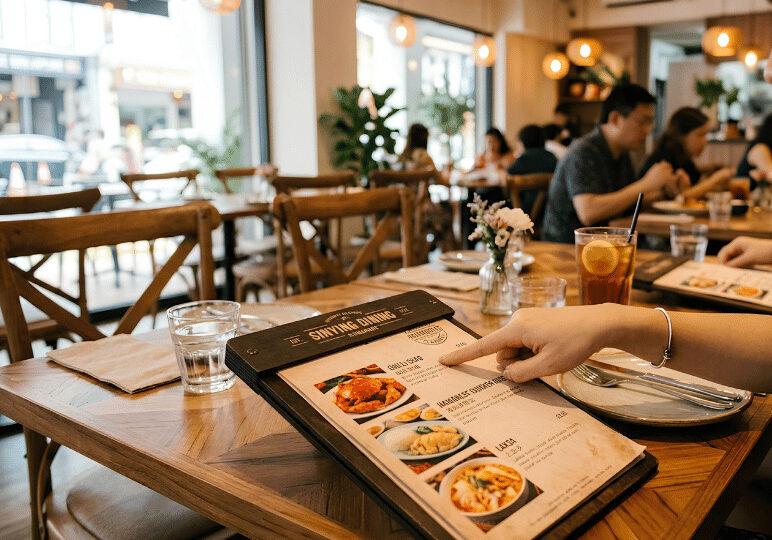
Yet even loyal diners rarely skip the menu entirely. They read descriptions they have no intention of ordering, scan specials boards, and pause over new additions.
Part of this is curiosity. Food offers a safe form of exploration. Reading a menu allows us to briefly step into different versions of ourselves: the person who orders oysters, the person who chooses the tasting menu, the person who always tries something new.
For a few moments, all of those possibilities remain open. The final choice may be familiar, but considering something different remains satisfying.
The Dishes That Live Only in Our Imagination
Every diner has encountered a dish they admire more than they actually want. Perhaps it sounds beautiful on paper but never suits the occasion. Perhaps it feels too rich, too adventurous, or simply too large for a weekday lunch.
Yet we continue reading it every time. We wonder what it tastes like. We tell ourselves we will order it next visit. Next visit arrives, and we choose something else.
Curiously, these never-ordered dishes still become part of our relationship with a restaurant. They contribute to the experience even without reaching the table.
More Than a List of Food
Restaurants often think of menus as practical tools. For diners, they can be something more.
A menu tells stories about a restaurant's ambitions, personality, and identity. Long before a dish arrives, we form impressions through the language, ingredients, and combinations before us. Even the dishes we never order help shape how we understand a place.
The menu becomes part of the atmosphere, a reminder of where we were, who we were with, and what the evening felt like before the first plate arrived.
The Pleasure of Choosing
Perhaps the real value of a menu is not the decision it produces. It is the small ritual that comes before it: imagining alternatives, exchanging recommendations, and briefly debating between trying something new and returning to a trusted favorite.
Most of the time, habit wins. The familiar dish arrives. Nobody regrets the choice.
Yet the menu has already done its work. It has reminded us that there were other possibilities. Not because we are searching for an answer, but because, for a moment, it is enjoyable to imagine all the versions of the meal that could have been.
To explore more of Singapore's dining culture, visit our homepage.